Free automated testing tool for web scraping, selenium automation, and data parsing — with 650+ configs
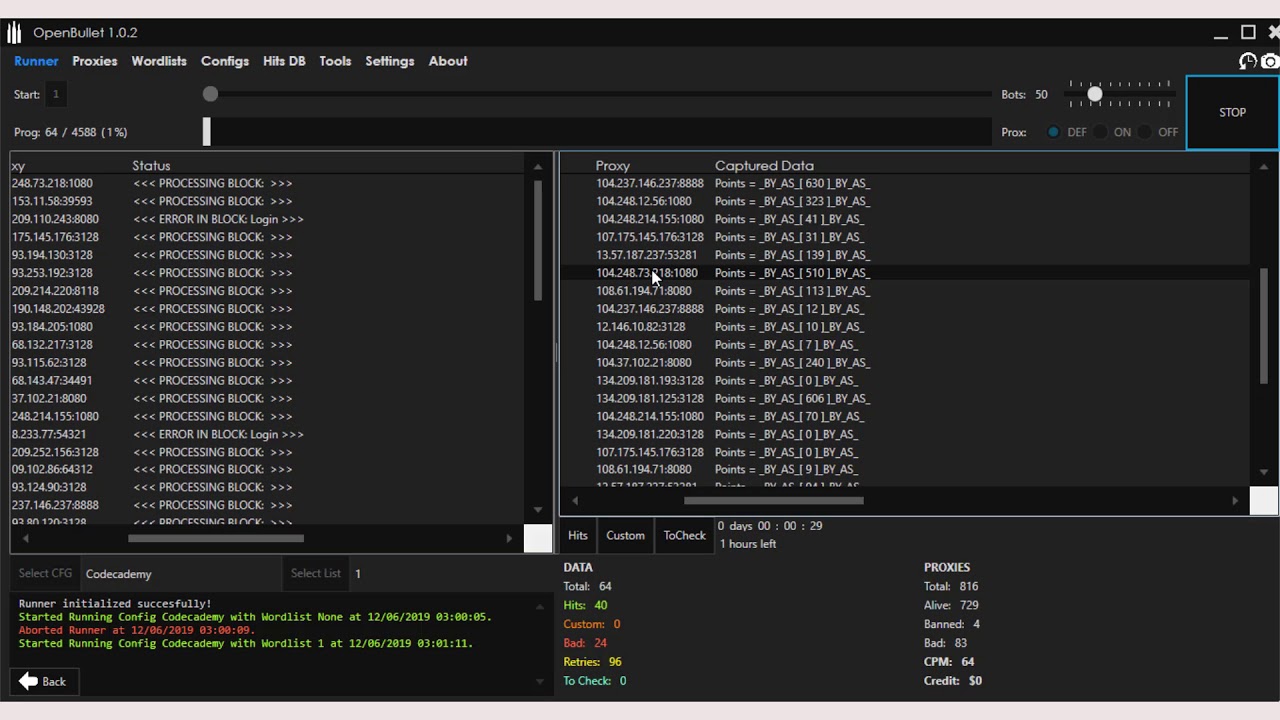
OpenBullet Anomaly is a powerful automated testing tool and web scraping suite that allows you to perform requests towards a target webapp and offers a lot of tools to work with the results. This software can be used for scraping and parsing data, automated pentesting, unit testing through selenium automation and much more. Download OpenBullet and SilverBullet configs for free from our store.
Powerful features designed for professionals
High-performance testing with optimized threading and proxy support for maximum speed.
Access to a vast library of pre-made configs for popular websites and services.
No ads, no tracking. Your testing activities remain completely private.
Download the latest updated version with 650+ configs included.
Password: openbullet.store
Download .RAR FileComplete cracking course with tools, audio explanation, video and text tutorials.
Advanced course for OpenBullet Anomaly & OpenBullet 2 [2026] with comprehensive materials.
IMPORTANT! Performing (D)DoS attacks or credential stuffing on sites you do not own (or you do not have permission to test) is illegal! The developer or this website will not be held responsible for improper use of this software.
OpenBullet configs is the result of numerous hours of passionated work from a small team of computer security enthusiasts. If you appreciated our work and you want to see OpenBullet configs kept being developed, please consider making a donation to our efforts via Bitcoin:
Bitcoin Address:
1CgAkPMgSG5SXvkTQnxU52HE2j8P9643Je
Arabic numerals (0, 1, 2, 3, 4, 5, 6, 7, 8, 9) are the most common symbols used worldwide to represent numbers in a positional decimal notation system . Despite the name, this system originated in India before being transmitted to the West through the Arab world.
Developed from Brahmi numerals , the system introduced two revolutionary concepts: positional value (where a digit's value depends on its place) and the symbol for zero as both a placeholder and a number. arabic numeral
Arab mathematicians like al-Khwārizmī adopted the Indian system, refining it and writing influential treatises that popularized it across the Islamic world. Arabic numerals (0, 1, 2, 3, 4, 5,
The development of these numerals spanned centuries and crossed multiple continents: Arabic numerals (0
While the underlying mathematical system is identical, the symbols (glyphs) differ by region: Letters as Numbers - by Joumana Medlej - Caravanserai