Enhanced/Dual Powered
Willem EPROM Programmer
User Guide
Main Board / Cables
Main Board PCB3.5
Main Board PCB4E

Main Board PCB5.0

Main Board PCB5.5C

|
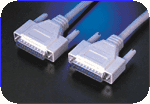
Parallel Data Cable (Printer extension cable, with male-female 25 pin connector, and pin to pin through) |
A-A type USB cable(for power) |
|
|
|
Optional Items:
|
ATMEL 89 Adapter |
ATMEL PLCC 44 Adapter |
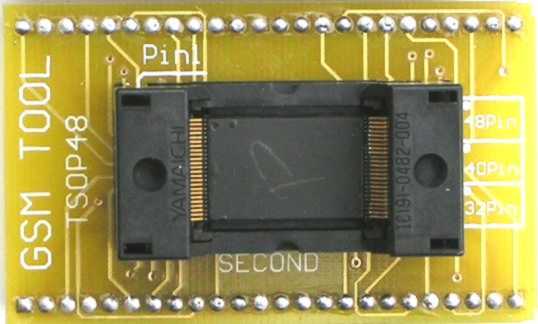
TSOP 48 Adapter |
|
|
|
|
|
FWH/HUB PLCC32Adapter |
PLCC32 Adapter |
SOIC Adapter(Simplified) |
|
On-Board |
On-Board |
|
|
AC or DC Power Adapter (9V or 12V, 200mA) |
SOIC Adapter(Professional) |
|
|
|
|
|
(1974) serves as the somber, blood-drenched finale to Hammer Film Productions’ iconic series, marking Peter Cushing’s final performance as the obsessive Baron Victor Frankenstein. Directed by Terence Fisher, the film strips away the gothic romanticism of earlier entries, replacing it with a nihilistic vision of scientific pursuit. The Architect of Madness
Frankenstein and the Monster from Hell is a gritty, claustrophobic end to an era. It concludes that the true "monster" was never the creature on the slab, but the man who refused to stop building it. The film ends on a chilling note: even after his creation is literally torn apart, the Baron immediately begins planning his next experiment, proving that his obsession is a cycle that only death can break. Frankenstein and the Monster from Hell(1974)
The asylum setting provides a potent metaphor for the Baron’s philosophy. To Frankenstein, the mentally ill are already "dead" to society, making their harvesting a matter of logic rather than cruelty. The film explores the "Hell" referenced in the title—not as a supernatural realm, but as the earthly condition of being stripped of one's identity. When the Monster eventually turns on its creator, it isn't an act of calculated revenge, but a spasmodic outburst of animalistic misery. Conclusion (1974) serves as the somber, blood-drenched finale to
The horror of the film stems from this "Professor" brain being trapped inside a primitive, violent body. Unlike previous iterations where the monster seeks companionship, this creature is a vessel of pure existential agony, unable to reconcile its sophisticated mind with its grotesque physical form. Themes of Dehumanization It concludes that the true "monster" was never
The "Monster" in this film is a radical departure from the flat-headed icon of the 1930s. Portrayed by David Prowse (later known for Darth Vader), this creature is a hulking, Neanderthal-like beast covered in thick, matted fur. It is a literal patchwork of the asylum’s residents: A suicidal giant. The Hands: A master sculptor. The Brain: A brilliant professor and friend of the Baron.
In this final chapter, the Baron is no longer a misunderstood visionary but a cold, institutionalized tyrant. Operating under the alias "Dr. Victor," he runs the pharmacy at Crowsheaven Asylum. Cushing portrays the Baron with a terrifyingly efficient detachment; he uses the asylum’s inmates as a literal "parts bin," viewing human beings only for their biological utility. His hands, scarred from a previous fire, necessitate the use of a protégé, the young Dr. Simon Helder, who serves as the audience’s surrogate into Frankenstein’s moral decay. The Creature as a Tragic Mosaic
Hardware Installation & Configuration
|
Installation Steps
(Note: the LPT port of PC MUST set to ECP or ECP+EPP during BIOS setup. To enter the BIOS setting mode, you need press "Del" key or "F1" key during the computer selftest, which is the moment of computer just power up.)
Software Version To Use | |||
| |||
|
| |||
|
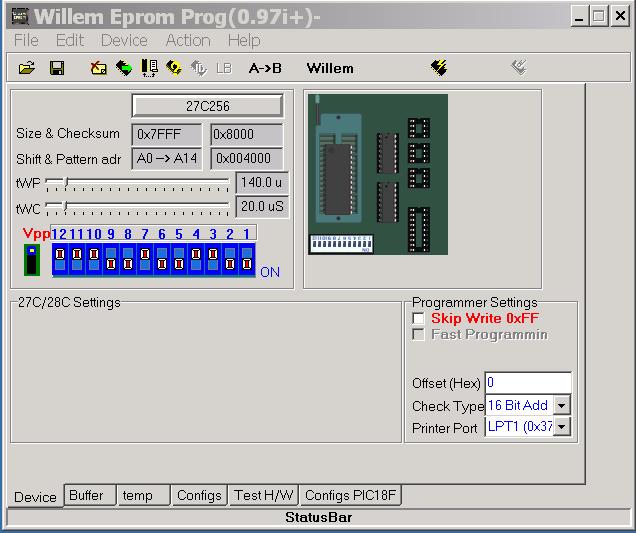
The software interface:
| |||
|
| |||
|
Hardware
Check
| |||
|
PCB3.5/PCB4E
PCB5.0
PCB5.5C
Note: the Vcc setting jumper only has effect when you are using AC adaptor as power source. For the USB power only 5V Vcc is available. For the PCB5.5C, set DIP steps: 1. press DIP Set button twice to check current DIP bit position. Then set it again for ON or OFF. 2. press DIP Bit shift button to shift the DIP bit position to where need to set. And then press DIP Set button twice to check current DIP bit position. Then set it again for ON or OFF. 3. Repeat those steps till all DIP bit ae set same as software indicated. For PCB5.5C voltage and Special chip selection: 1. Put back the safety jumper. 2. Press the voltage button and hold for 1 second, the voltage LED should move to next. Repeat till desired voltage LED light up. 3. Press the chip selection button and hold for 1 second, the chip LED should move to next. Repeat till desired LED light up. 4. Remove the safety jumper to lock the selected voltage and chip selection
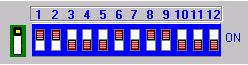
DIP Switch (PCB3.5, PCB5.0)
When programming one chip, follow the program prompt to set DIP switch .
|
(1974) serves as the somber, blood-drenched finale to Hammer Film Productions’ iconic series, marking Peter Cushing’s final performance as the obsessive Baron Victor Frankenstein. Directed by Terence Fisher, the film strips away the gothic romanticism of earlier entries, replacing it with a nihilistic vision of scientific pursuit. The Architect of Madness
Frankenstein and the Monster from Hell is a gritty, claustrophobic end to an era. It concludes that the true "monster" was never the creature on the slab, but the man who refused to stop building it. The film ends on a chilling note: even after his creation is literally torn apart, the Baron immediately begins planning his next experiment, proving that his obsession is a cycle that only death can break.
The asylum setting provides a potent metaphor for the Baron’s philosophy. To Frankenstein, the mentally ill are already "dead" to society, making their harvesting a matter of logic rather than cruelty. The film explores the "Hell" referenced in the title—not as a supernatural realm, but as the earthly condition of being stripped of one's identity. When the Monster eventually turns on its creator, it isn't an act of calculated revenge, but a spasmodic outburst of animalistic misery. Conclusion
The horror of the film stems from this "Professor" brain being trapped inside a primitive, violent body. Unlike previous iterations where the monster seeks companionship, this creature is a vessel of pure existential agony, unable to reconcile its sophisticated mind with its grotesque physical form. Themes of Dehumanization
The "Monster" in this film is a radical departure from the flat-headed icon of the 1930s. Portrayed by David Prowse (later known for Darth Vader), this creature is a hulking, Neanderthal-like beast covered in thick, matted fur. It is a literal patchwork of the asylum’s residents: A suicidal giant. The Hands: A master sculptor. The Brain: A brilliant professor and friend of the Baron.
In this final chapter, the Baron is no longer a misunderstood visionary but a cold, institutionalized tyrant. Operating under the alias "Dr. Victor," he runs the pharmacy at Crowsheaven Asylum. Cushing portrays the Baron with a terrifyingly efficient detachment; he uses the asylum’s inmates as a literal "parts bin," viewing human beings only for their biological utility. His hands, scarred from a previous fire, necessitate the use of a protégé, the young Dr. Simon Helder, who serves as the audience’s surrogate into Frankenstein’s moral decay. The Creature as a Tragic Mosaic