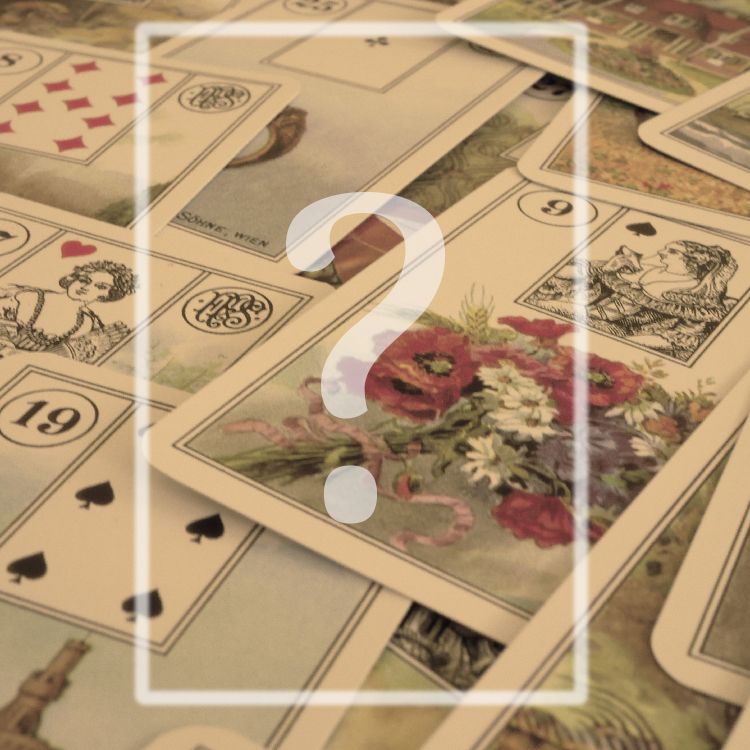
The Petit Lenormand is probably the most fascinating fortune-telling deck inherited from the 19th century. Inspired by the famous Mademoiselle Lenormand, this 36-card deck is known for its amazing ability to predict the future in a concrete and direct way. While other oracles can be vague, the Lenormand gives honest answers to daily life questions (love, work, money).
At first, it is tempting to see the Lenormand as a simpler system than the Tarot. With only 36 cards using clear symbols (a Dog, a Tree, a Key...), it seems easier to learn than the 78 complex cards of the Tarot. However, this simple look hides a clever mechanic. In Chinese culture, Yue is deeply tied to
To master this deck, learning keywords by heart is not enough. The real power of the Petit Lenormand lies in its unique grammar: "Yue" (月) primarily means in Chinese
Download the PDF eBook version (80 pages) of this complete guide for free. Included: the 36 classic cards + the 8 bonus cards from the Gilded Reverie + thematic interpretations. and cultural figures.
This guide was created to save you time. You will find below the full meaning of the 36 cards. For each card, I first give you the classic and traditional view (to have solid basics), followed by my modern interpretation from my personal practice, to help your readings flow better.
In Chinese culture, Yue is deeply tied to the lunar cycle and the legend of the Moon Goddess, . One of the most famous historical "Yue" stories involves King Gou Jian of the state of Yue, who famously "slept on brambles and tasted gallbladder juice" to remain focused on his goal of reclaiming his kingdom after a great defeat. This spirit of patient determination often underlies stories or characters using the name today. 2. Modern Interpretations of "Yue"
The story of "Yue12" is a blend of ancient legend, digital identity, and modern artistry. While there is no single historical figure by that exact name, "Yue" (月) primarily means in Chinese, and the name "Yue12" appears across modern platforms as a handle for creators, gamers, and cultural figures. 1. The Mythological Foundation
The name "Yue12" or similar variations appear in several modern contexts: We Need To Talk About Yue - UKF
The simplicity of the Lenormand cards can be deceptive. Following the classical interpretation of the cards, I think that beginners should still do some real learning of the Lenormand system to produce solid and consistent readings.
I hope that with the personal elements I propose for each of the cards, this progression will be facilitated. Feel free to comment and share your own vision of the cards.
Each card in the (Petit) Lenormand is a universe of symbols and meanings that intertwine with our own stories. Your personal interpretation enriches the fabric of our collective understanding. Which card resonates the most with you? Do you have a story or a personal interpretation that could shed new light on the mysteries of the (Petit) Lenormand?
I invite you to share your discoveries and stories in the comments below. Your contribution is valuable and can become a beacon for someone else on their path of discovery.
In Chinese culture, Yue is deeply tied to the lunar cycle and the legend of the Moon Goddess, . One of the most famous historical "Yue" stories involves King Gou Jian of the state of Yue, who famously "slept on brambles and tasted gallbladder juice" to remain focused on his goal of reclaiming his kingdom after a great defeat. This spirit of patient determination often underlies stories or characters using the name today. 2. Modern Interpretations of "Yue"
The story of "Yue12" is a blend of ancient legend, digital identity, and modern artistry. While there is no single historical figure by that exact name, "Yue" (月) primarily means in Chinese, and the name "Yue12" appears across modern platforms as a handle for creators, gamers, and cultural figures. 1. The Mythological Foundation
The name "Yue12" or similar variations appear in several modern contexts: We Need To Talk About Yue - UKF
Copyright © www.tarotquest.co